
Change Management Plan Towards a Circular Economy in the Industrial System of Terrassa (2025–2027)
Technical assistance for the revitalization of a participatory process aimed at identifying, prioritizing, and defining concrete actions for the 2025–2027 Action Plan of the Bioeconomy Strategy of Catalonia 2030 (EBC 2030), involving the main stakeholders of the public and private bioeconomy ecosystem in Catalonia.

Location
Terrassa, Vallès Occidental, Catalonia (Spain)
Year of Start
2023
Promoter
Ajuntament de Terrassa
Objective
This project develops one of the opportunities detected in the Terrassa Strategic Plan for Circular Economy, focusing on increasing the use of materials through the reduction of common waste (mixture) and the activation of local value chains.
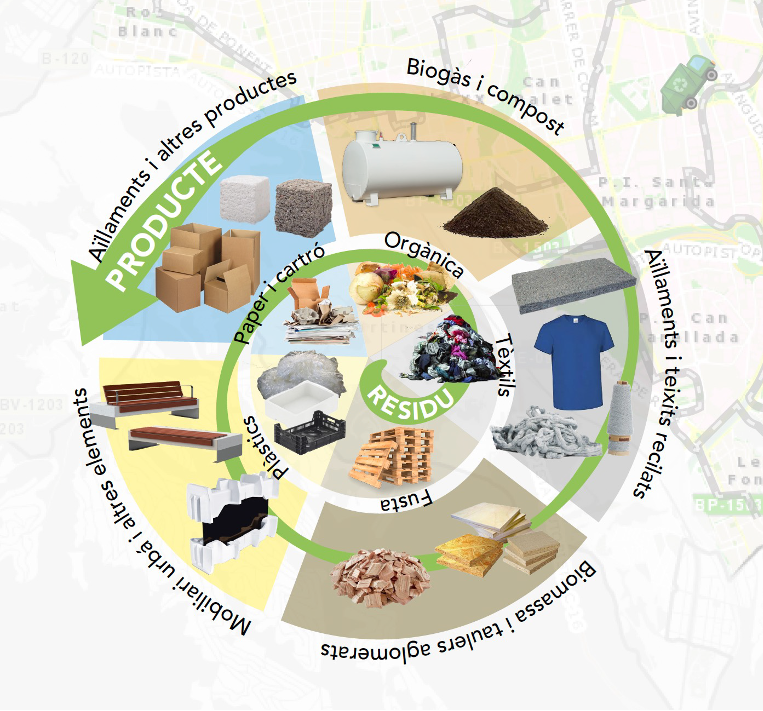
To this end, the complete value chain of the materials is analyzed, identifying key actors and opportunities both in waste recovery (reduction of management costs) and in incorporating recycled materials into products and processes. The approach seeks to facilitate a realistic deployment of circularity initiatives with an impact on the industrial fabric of Terrassa.
The work includes visits to management plants, characterization and quantification of waste, mapping of generating companies and potential users of materials/solutions, identification of technologies and suppliers, and a presentation day as a starting point to develop the value chains.
Results obtained
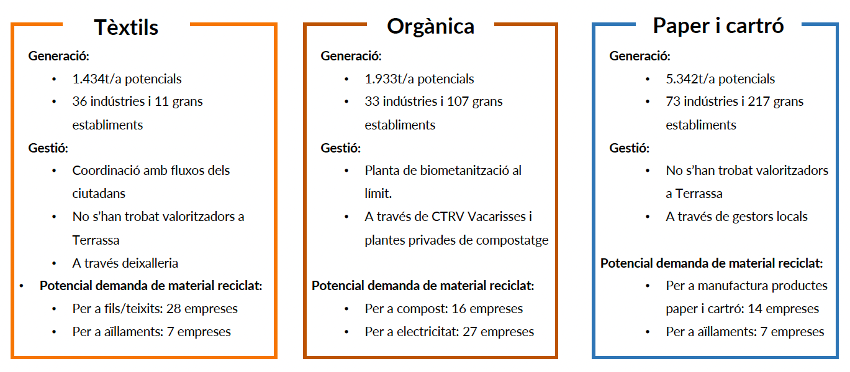
- Map of resources and value chains: waste and generators → materials and managers/valorizers → product and potential market.
- Estimated socioeconomic impact: potential for creating 29 jobs in Terrassa.
- Estimated environmental impact: emission reduction of 5,000 t CO₂/year.
- Operational conclusion: need to identify and involve local valorizers and to promote separation at source with public support to close material cycles.
To highlight
- Calculation of the potential of materials present in the common industrial fraction combining data from the sorting plant and literature.
- Proposal of outputs for materials with low weight/volume ratio (e.g., film and expanded polystyrene), usually destined for landfill.
- Comprehensive approach: from generation and management, to final product and potential market.
- Public role as an agent with territorial vision to connect actors and facilitate deployment.