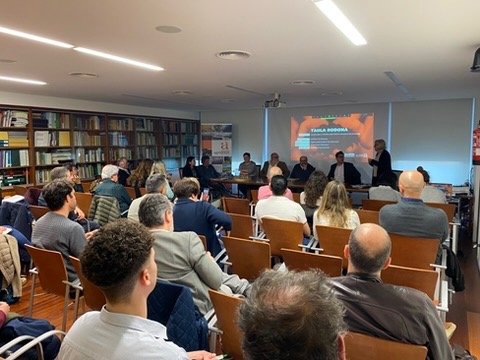
Last Wednesday, March 26, the presentation day of the Catalan Digestate Strategy took place at the headquarters of the Official College of Agricultural Engineers in Barcelona, co-organized by the Climate Change and Circular Economy Commission of the Official College of Industrial Engineers of Catalonia and the Energy Transition and Climate Shock Commission of the Official College of Agricultural Engineers of Catalonia.
The conference coincided with the publication in the DOG of the Catalan Digestate Strategy, approved by the Government. According to Ms. Neus Ferrete, Deputy Director General of Agriculture of the Department of Agriculture, Livestock, Fisheries and Food of the Generalitat de Catalunya, this strategy is a fundamental piece linked to the Catalan Biogas Strategy, since the decarbonization objectives of the latter cannot be achieved without efficient management of the digestate generated in the recovery process. The Deputy Director explained the objectives of the strategy and how, based on the analysis of regulatory, economic, technological, environmental and social barriers, the challenges of the sector have been identified and key actions have been defined to guarantee
sustainable management of digestate in its application to soil fertilization.
Next, Mr. August Bonmatí, from IRTA, presented a technical paper on the technologies available for the recovery of both the solid fraction of the digestate and the liquid fraction, analyzing how and when to implement them. He highlighted the
concentrated final products that can replace chemical fertilizers and the importance of finding a suitable use for the remaining liquid fractions as a water resource in the territories near biogas plants.
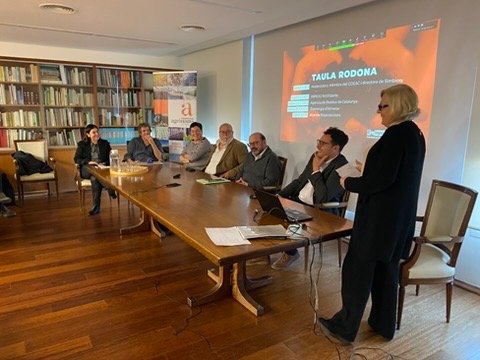
Finally, a round table was held with various actors from the digestate sector. Mr. Francesc Giró, from the Catalan Waste Agency; Mr. Martí Cabré, from the company Inprog, specialized in fertilizer production; Ms. Núria Bernaus, from Bioenergía d’Almenar; and Mr. Jordi Jové, from Alcarràs Bioproductors, participated. This table discussed the main challenges faced by these facilities and how the Catalan Digestate Strategy could contribute to overcoming them:
- Search for solutions to the double administrative procedure (agricultural management plan and waste management).
- The need for scale in digestate plants to be profitable and the involvement of local investors from the primary sector.
- Ensure that the resulting by-products are profitable for farmers, considering the increase in agricultural productivity.
- The importance of co-digestion with waste from different origins, always ensuring the quality of entry and overcoming existing legal barriers.
- The viability of other uses of digestate with toxicity in the soil, such as thermal oxidations.
- Define control parameters based on the needs of the crop and the different types of soil.
- Identify successful models that allow achieving the objectives of both the Catalan Digestate Strategy and the Catalan Biogas Strategy.
This conference highlighted the role of the different professional associations and their ability to work together to advance key solutions for sustainable development in Catalonia.
Consult the Catalan Digestate Strategy
here.